
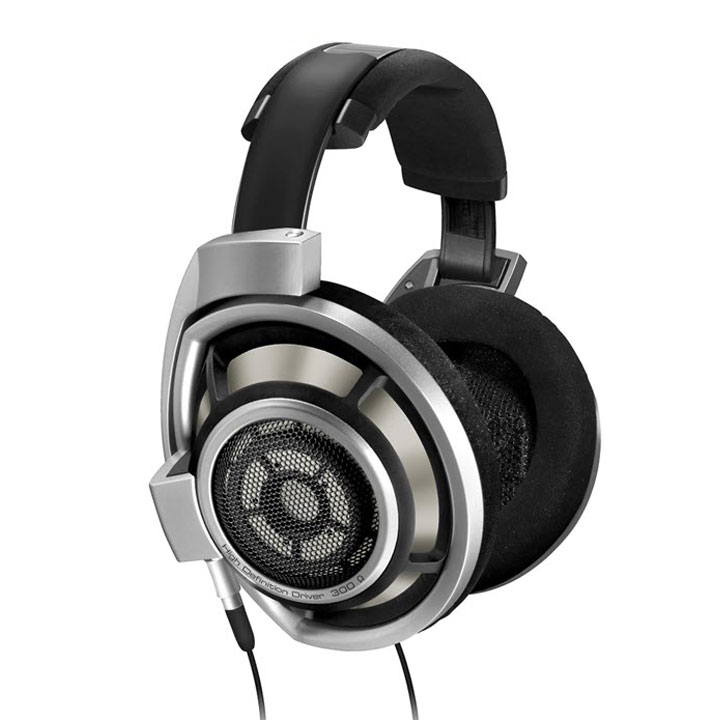
Sennheiser HD800S FilterSet
The Sennheiser HD800S Neutral FilterSet contains convolution filters with sample rates from 44.1 kHz to 352.8 kHz and packaged as a .zip file that can be used in most convolvers, like Hang Loose Convolver and Roon for example. Mono 352.8 kHz mono filters are also included for HQPlayer.
Full Product Description
Frequency Response Measurement & Correction
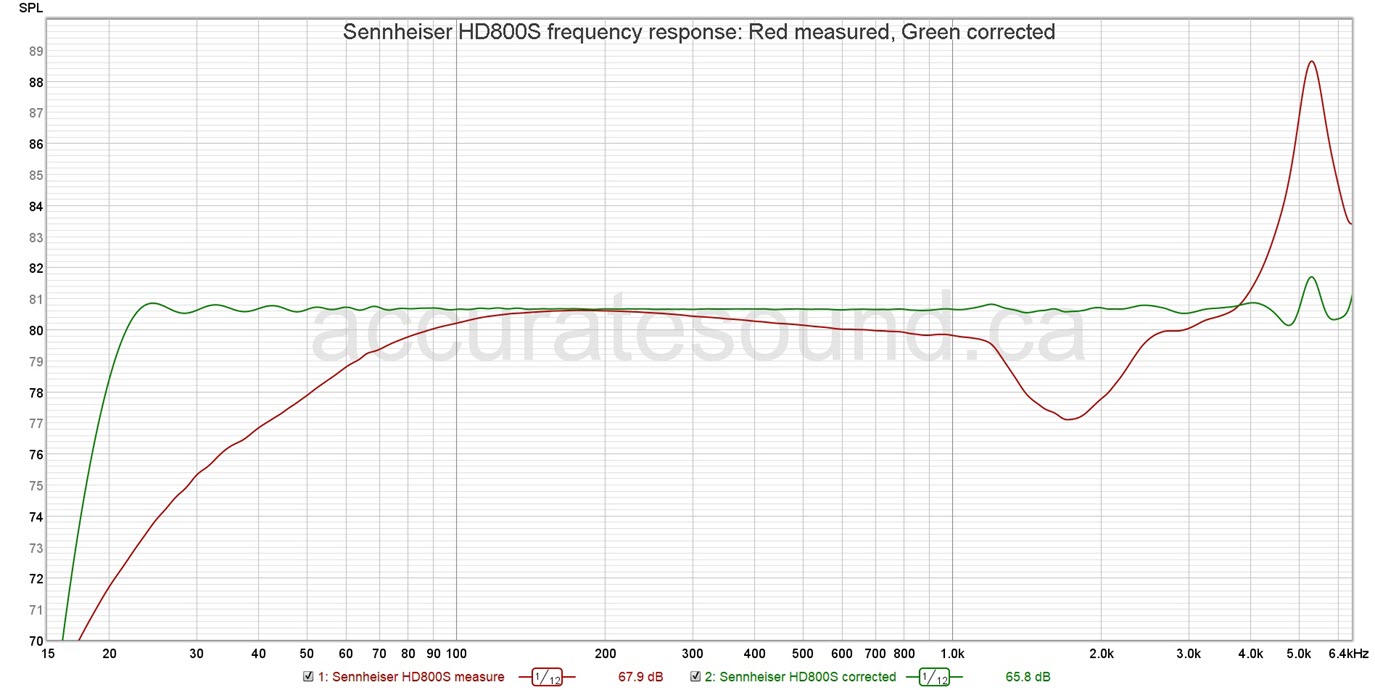
While similar to the frequency response of the HD800, the HD800S has a bit less of the “dentist’s drill” high frequency peak at 5.25 kHz. The bass starts to roll-off at 125 Hz and is -9 dB down at 20 Hz. There is a broad dip of -4dB in then ears most sensitive range around 2 kHz. The “house sound” of the HD800S, like the HD800, is a bright, bass-light sounding headphone.
Engaging the high-resolution convolution filter transforms these headphones into a highly accurate sound reproducer without the high frequency peak drilling into one’s ears. Bass is extended to -2dB down at 20 Hz, and with the large dynamic drivers, is bass one can feel. A personal favorite here at Accurate Sound.
6 reviews for Sennheiser HD800S FilterSet
You must be logged in to post a review.

Andrew –
I have limited experience with the HD800 series. I bought them around 2017 but quickly sold them off as that wasn’t the sound I was looking for, it was a bit strident, and I didn’t have the chain for it.
Fast forward to today, I’ve been focused on dynamics the past couple of years. Most of my headphones are still planars, I have ESL speakers (Martin Logan 13as) – but I got a local DNA Stellaris with full upgraded tube complement a couple years ago. The amp, I’ve discovered, is so good – you find the headphones that fit the amp and not necessarily the other way around.
I started with the Utopia 2022. It was sensational. Despite all my headphones – Utopia and Caldera have become my favorites, and they are the best all arounders: Utopia as a dynamic, Caldera as a planar (with the thick pads).
Wanted a new toy to play on the DNA Stellaris so I said F it and bought an HD800s. Initially through the Stellaris they didn’t have any edge, the soundstage was huge – reminding me of the Stax 009 and Susvara (that I ended up selling off for various reasons). They didn’t lack bass weight, but punch and drive. Soundstage was huge, but a bit diffuse. I end up listening to a lot of jazz trios and for this – they are great. Overall, I really enjoyed them through the tube amp in stock form.
So, I’m not sure how many of you know Mitch at Accurate sound. He makes convolution filters that flatten headphones curve up to the frequency where HRTF takes over. I really like his filters. I’ve tried them on all my headphones ( and some of my previous ones, like the Susvara) – and my favorite up to this point has been Lcd-5 (I can’t listen without it, it’s too mid forward) – and LCD-4 (sounds good both ways but Mitch’s filter is much more linear and my preference).
So I listened to the HD800s all weekend on the Stellaris and it was extremely pleasant. A specialist headphone for sure but one I’d enjoy.
I bought Mitch’s filter on Monday, because I knew it was inevitable. I had been listening to the Caldera through my Enleum 23r, and as the amp was warm, I threw on the HD800s. Listened for a while. then through on the filter. “What is going on” was my first thought. Let me explain. Mitches filter essentially flattens the response below 6-7k with a convolver so minimal it creates no phase issues. It apparently address 3 things 1) Bass extension all the way down 2) Basically completes removes he 6k peak (it’s down to like +1 dB in his chart) 3) And, it fille in the dip between 1 -3k.
Of the changes, I had not expected the 1-3k fill in to make the most change but it did. The peak didn’t really bother me, but removing it made it better, the bass had been there previously but now it actually can drive, and the amazing soundstage was retained but the images were no longer diffuse but had this solidity. With the upper mids filled in suddenly everything snapped into focus and the imaging went from diffuse to just right.
I listened to some Al Di Meola and the resolution and speed of the HD800s still competes with flagships today. I was getting no fatigue, but I could see on a solid state set up – on music like this with this amp, it might be too much after a couple hours. It was caffeinated but linear. Good for certain moods, but not the mood I was in.
So, I turned the filter on – turned the Stellaris to Low Z (because I didn’t want to give up the newfound drip and driver control), let it warm up for 30-45 minutes …. and wow. This reminded me of first listening to the Utopia on the Stellaris. This is what I wanted Susvara to be: I always appreciated it’s technicalities, but I just don’t like the hifiman tuning.
I ended up listening for the next 3-4 hours, and I am very rarely wowed by audio anymore. I was wowed. The secret was Mitch’s filter. When he corrects the tonality of the HD800s, the drivers capabilities are able to completely come through. Obviously having a god tier amp for dynamics helped as well – but it wasn’t the same before the filter. It went from “This is a nice complementary headphone to my collection” to “This headphone is as good as any headphone I have in this system”. It suddenly became compatible with all these genres of music that it previously was not. I was listening to and enjoying vocal based music, Dark Side of the Moon. Thinks that were well recorded and had a lot of space. Songs I liked that weren’t particular well recorded.
My favorite test album- especially with the Stellaris is Michael Giacchino “Exotic Themes for the Silver Screen”. There is so much reverb and spatial information that with tubes, and the right headphone, the soundstage can extend to infinity. It made me laugh out loud when I first heard the Utopia on the Stellaris, and I had that same reaction when I heard the filtered HD800s for the first time.
I just kept thinking: how the heck is a 16 year old headphone design and a convolution filter this good? I have to say, while I’ve always liked Mitch’s filters, the impact depends on the headphones. Sometimes I like the headphone better with the filter, sometimes I like the headphone better stock. Sometimes I like both as changes of pace. The HD800s filter was, however, completely transformative. I’ll never listen without it again.”
Tolga Altuntas (verified owner) –
Mitch, it’s really hard to describe the results with words, but I wanted to wait a bit before writing a review to do a more detailed analysis. Thank you so much for all your hard work. You’ve accomplished something incredible—I tried to summarize it as best I could below.
The Accurate Sound filters for the Sennheiser HD800S are nothing short of revolutionary. Paired with my Dekoni Hybrid earpads, Schiit Mjolnir 3 (balanced low gain no feedback), and Vanish Premium cable, they’ve completely transformed the HD800S into a headphone I can listen to for hours without fatigue—something the stock version could never achieve.
The HD800S Brightness Problem Solved
Stock HD800S owners know the issue: crystalline treble that turns harsh after 45-60 minutes, sibilance on vocals, and piano/cymbal glare that demands EQ. These filters target the classic 6-10kHz peaks with surgical precision:
Sound Quality Transformation
Before Accurate Sound: Analytical monitor—stunning detail but fatiguing for long sessions
After Accurate Sound: Reference flagship that disappears—you forget you’re wearing headphones.
Tonality: Perfectly natural across the spectrum. Female vocals (Norah Jones) buttery smooth, male vocals authoritative yet warm. Piano has proper wooden body, not just attack. Brass instruments golden without bite.
Technical Performance:
Soundstage: Stock width maintained + deeper layering (orchestra rows perfectly separated)
Imaging: Pinpoint holography—hear violin bow direction, pick hand position
Separation: God-tier instrument placement (5+ violins in quartet fully resolved)
Blackness: Ink-black backgrounds, ultimate microdetail retrieval
Dynamics: Improved macro swings—pp to ff transitions effortless
Genre Performance (Hours of Bliss)
Jazz (Bill Evans “Waltz for Debby”): Piano decays hang forever in perfect hall space, cymbals shimmer without splash, bass double-stops fully resolved
Vocals (Norah Jones “Come Away With Me”): Intimate chest voice, breath sounds natural, no sibilance
Classical: Orchestra breathes—string sections have individual voices, timpani texture visible
Blues/Rock: Guitar overtones rich, snare snap visceral, kick drums hit chest
The Endurance Factor
This is the breakthrough: 4+ hour sessions fatigue-free. Stock HD800S demands breaks; this modded version disappears completely. The treble is now “reference pleasant”—extended sparkle without edge. Comfort + sound = true flagship endurance.
Vs $10k+ CanJam Rigs
After demoing everything at CanJam NY 2026, this HD800S + Accurate Sound + Mjolnir 3/Yggy Less is More beats every $10k+ combo I heard. Chinese assembled flagships costing 3-4x more can’t match this synergy of natural tonality, technical resolution, and listening stamina.
Verdict: Every HD800S owner needs Accurate Sound filters immediately. They’ve given my flagship a completely new identity—endurance reference that redefines what “hours of listening” means. 10/10, life-changing mod.
Julian (verified owner) –
Stunning. I’ve tried various eq presets in Roon and never been convinced. These filters aren’t modelled on a target, but a flat response, so you get a flat bass response all the way down to around 20k. Everything is very clear and precise. Also, if you want to use a target curve, you can add further EQ but starting from a flat response – not that I think it needs it. I was about to spend big bucks on new headphones but thought I’d try these first. Highly recommended
Mike D (verified owner) –
I thought my HD 800 S already synergized perfectly with my chain (Mercury V3 → Gungnir 2 → Mjolnir 3), but Accurate Sound’s convolution filters have taken them to an entirely new level. The familiar wide soundstage, micro-detail, and lightning-fast transients are still intact, yet the presentation is no longer dry or clinically bright.
The filters neutralize the residual treble glare and gently lift sub-bass, giving the HD 800 S a weighty, coherent low-end that anchors music across genres. What surprises me most is the increase in emotional engagement. Music feels fluid, organic, and immediate, letting me forget about the gear and simply listen.
For the modest cost of a filter pack, this is hands-down the best value upgrade I’ve made in headphone audio. Accurate Sound has turned an already reference-grade headphone into a transparent, utterly musical window. Highly recommended.
Franz Hellerschmid (verified owner) –
I admit that I used my Sennheiser’s 800s Headphones less and less. Last month, after I moved to a new home, I visited Mitch’s home page, because I need new convolution filters for my set-up. There I discovered the for me, all new headphone filters. So I bought the filters for the Sennheiser HD 800s.
And here the sun began to shine. I was really shocked and shook my head in disbelieve. Everything I looked for in the HD 800s is now there. Precise bass, great midrange and treble. It is like a complete new high-end headphone. Mitch delivers excellent work and real value for his costumers. If you want to improve your headphone listening by a huge margin, get Mitch filters. You won’t be disappointed.
vess1an (verified owner) –
A filterset that shows why the HD800S is a DSP reference
The HD800S was my personal worst lineup
with its childishly tinny bass and tired treble.
But now, along with the Susvara and HD650, it’s become my workhorse.
This resolution is on par with the best planar headphones.
After applying the filter, it still seems to have more treble than I’d like, but compared to the original, it’s a world of difference.